Chapter 78 — Announcements
A new office opens, open enrolment closes on Friday, the travel policy changes. HR needs a place to say it once, to the right people, and know it reached them. Email alone scatters these notices across inboxes; an announcement board keeps the current ones in one place in the portal, with an email for the ones that cannot wait.
What this chapter covers
- 78.1 Creating an announcement: audience, priority, category
- 78.2 Scheduling, expiry, pinning, email notification
- 78.3 Draft, published, archived; categories
- 78.4 What employees see and read tracking
- 78.5 Must-read announcements
- 78.6 Reactions and comments
The concept
Good internal communication targets its audience, says how much it matters, and has a shelf life. A notice for the Denver office should not reach London; an urgent one should look urgent; and last quarter's all-hands link should leave the board once it is stale. Fewer, better-aimed announcements get read; a board everyone ignores is worse than none.
How Operentra handles it
- Announcements in the admin menu has All Announcements, Create and Categories; employees read them under Announcements in the portal and in the Recent Announcements panel of their portal home.
- An announcement has a title, a body, a priority (Normal, Important or Urgent), an optional category, and an audience: all employees, or chosen departments, branches, roles or people.
- Publish At schedules it; Expires At ends it; Pin keeps it at the top; Send Email Notification emails the audience when it goes live, with a bell notification for those who sign in.
- It is a draft until published, and is archived when done.
- Who:
announcements.manageto write and publish (Super Admin, HR Manager, HR Officer); every role reads them.
Walkthrough
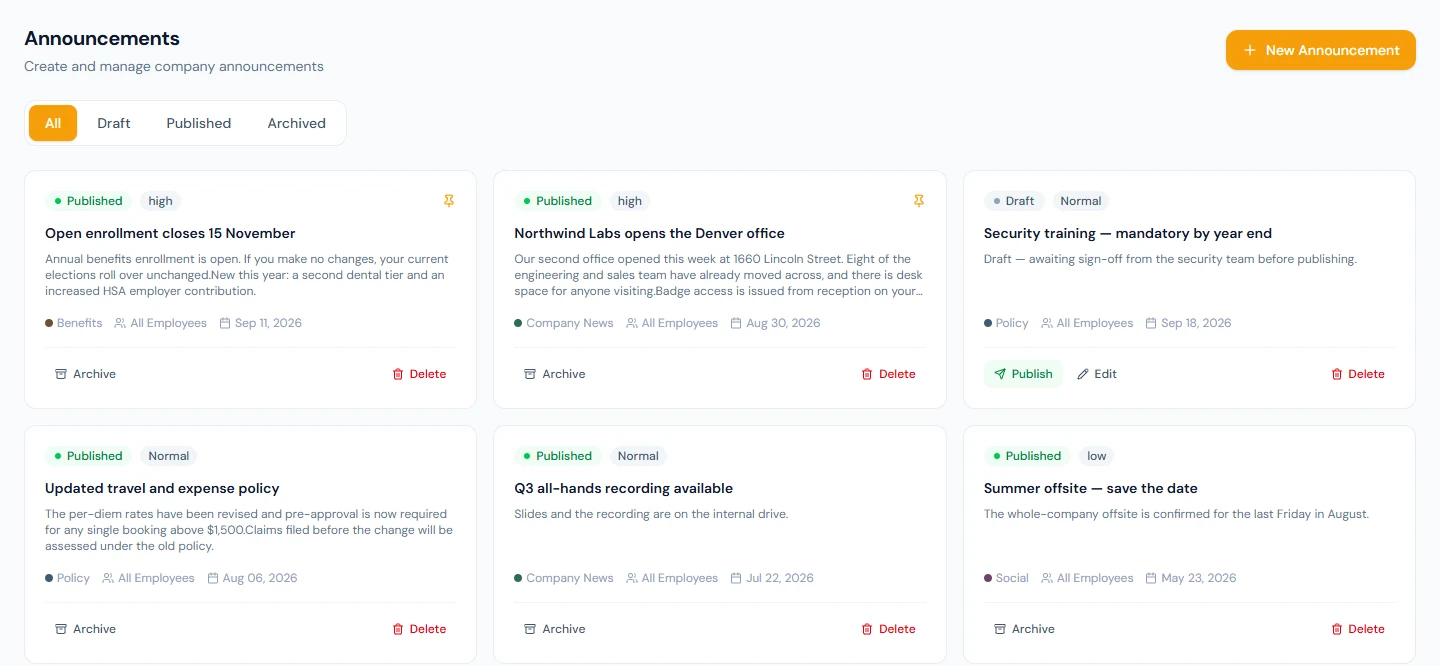
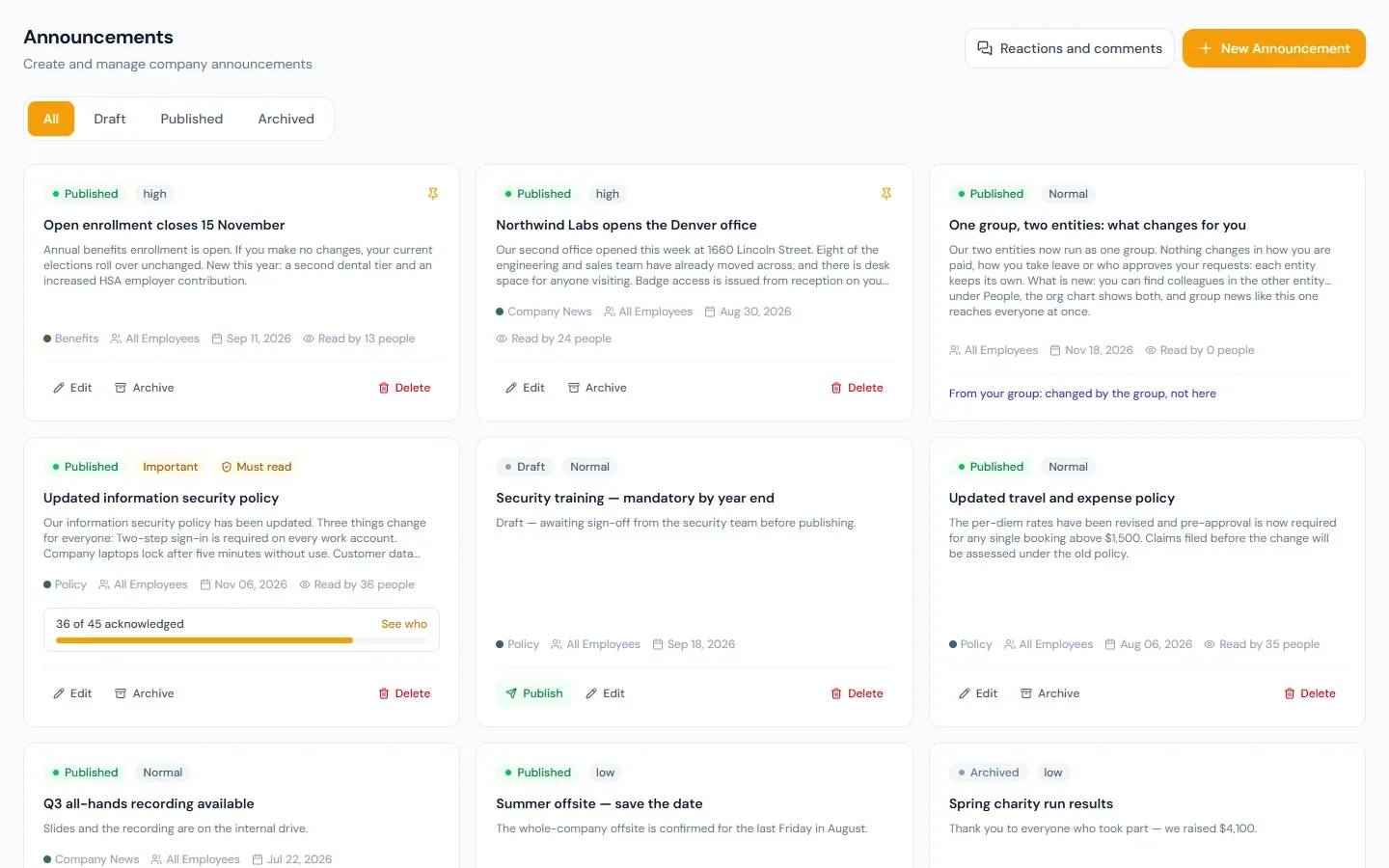
Northwind has seven announcements: "Northwind Labs opens the Denver office" and "Open enrollment closes 15 November", pinned; three more published; "Spring charity run results", archived; and "Security training — mandatory by year end", a draft.
78.1 Creating an announcement: audience, priority, category
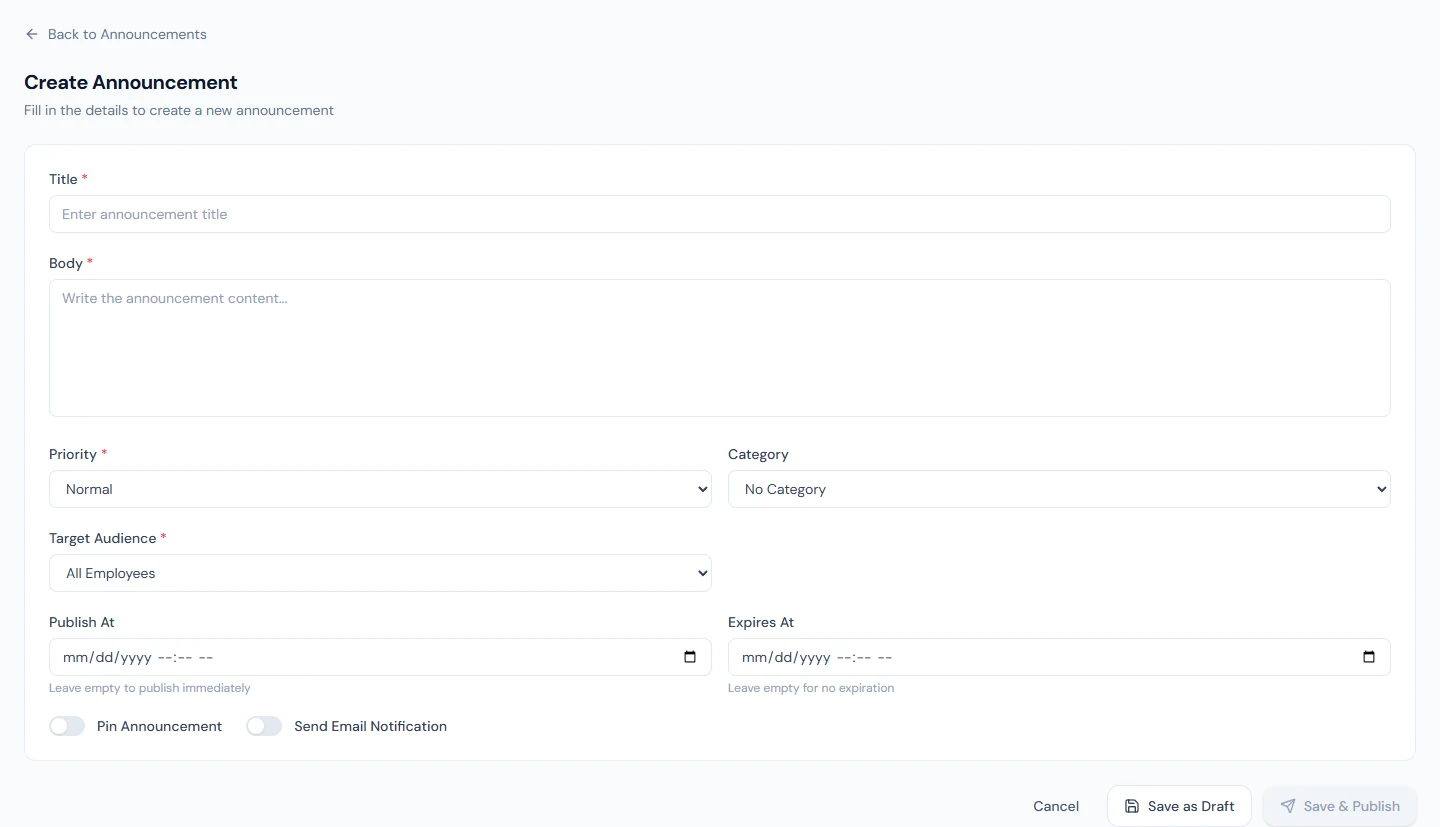
Announcements › Create asks for a Title, the Body (plain text; line breaks are kept), the Priority (Normal, Important, Urgent), an optional Category, and the Target Audience:
| Audience | Who sees it |
|---|---|
| All Employees | Everyone |
| Department | Employees of the departments ticked |
| Branch | Employees of the branches ticked |
| Role | Users holding the access roles ticked (Department Head, HR Manager, …) |
| Specific Employees | The people ticked |
Role means an access role (Chapter 14), not a job title. An announcement for the security training would go to everyone; a note about the Denver office car park to that branch only.
78.2 Scheduling, expiry, pinning, email notification
Publish At holds a published announcement back until that time ("Leave empty to publish immediately"); Expires At removes it from the board at that time ("Leave empty for no expiration"). Both are entered in your local time. Pin Announcement keeps it above the rest. Send Email Notification emails each person in the audience once, when it goes live: at publication, or within ten minutes of a scheduled Publish At. The email, "… — Northwind Labs, Inc.", carries the title and the first lines as written, with the rest of the email in each recipient's language; those who sign in also get a bell notification. Only active employees with an email address are mailed.
78.3 Draft, published, archived; categories
Save as Draft keeps it private; Save & Publish asks "Save and publish this announcement?" and makes it visible to its audience (from Publish At, if set). The list, with tabs All, Draft, Published and Archived, offers Publish and Edit on a draft, Archive on a published one and Delete on any, which removes it for good. A scheduled or expired announcement still reads Published; it is simply not on the board outside its dates. Archive it when it no longer matters.
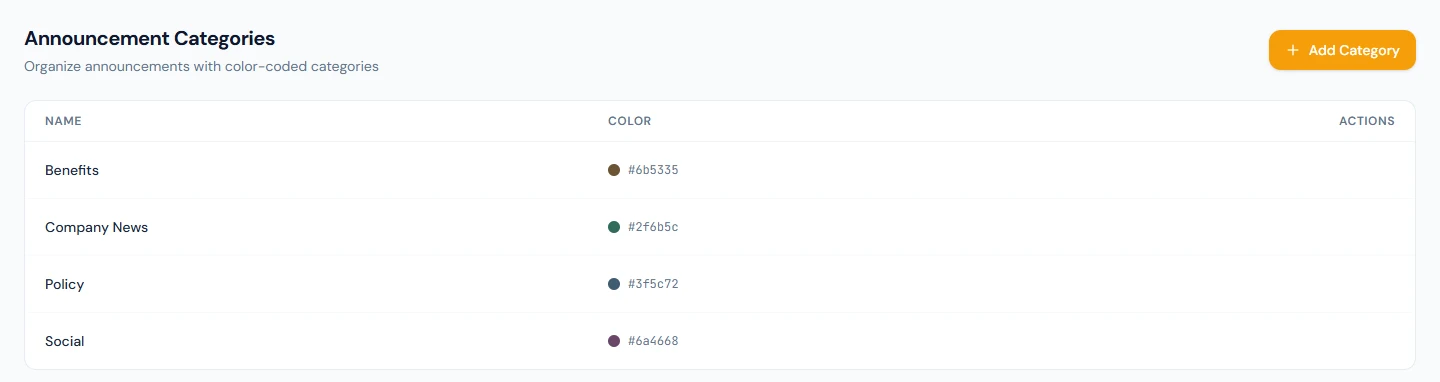
Categories ("Organize announcements with color-coded categories") have a name and a colour: Northwind uses Company News, Policy, Benefits and Social. Deleting a category leaves its announcements uncategorised.
78.4 What employees see and read tracking
The portal's Announcements page lists the live announcements for the person signed in, pinned first, then newest, each with its priority, category, date and author (or "by a former employee" when the author's data has since been erased, Chapter 93; the announcement itself stays); Read opens the full text and any expiry date. The portal home's Recent Announcements shows the five newest from the same list. Opening an announcement with Read records that the person read it, and each published card in the admin list shows Read by N people. A read is not a confirmation, and the list gives a number, not names. For something everyone must confirm, make it a must-read (78.5).
78.5 Must-read announcements
The Must read switch on the form turns an announcement into one each person in its audience has to confirm. It is separate from Priority: Urgent is a label, Must read is a stop.
Once it is live, each active employee in the audience meets it the next time they open Operentra, in the portal or the admin area. The announcement is shown over the page and cannot be closed; I have read this records the confirmation with its date and time and lets them through. Several pending ones are shown one at a time, oldest first. Someone who joins the audience later is asked then, and nobody is asked once the announcement expires or is archived.
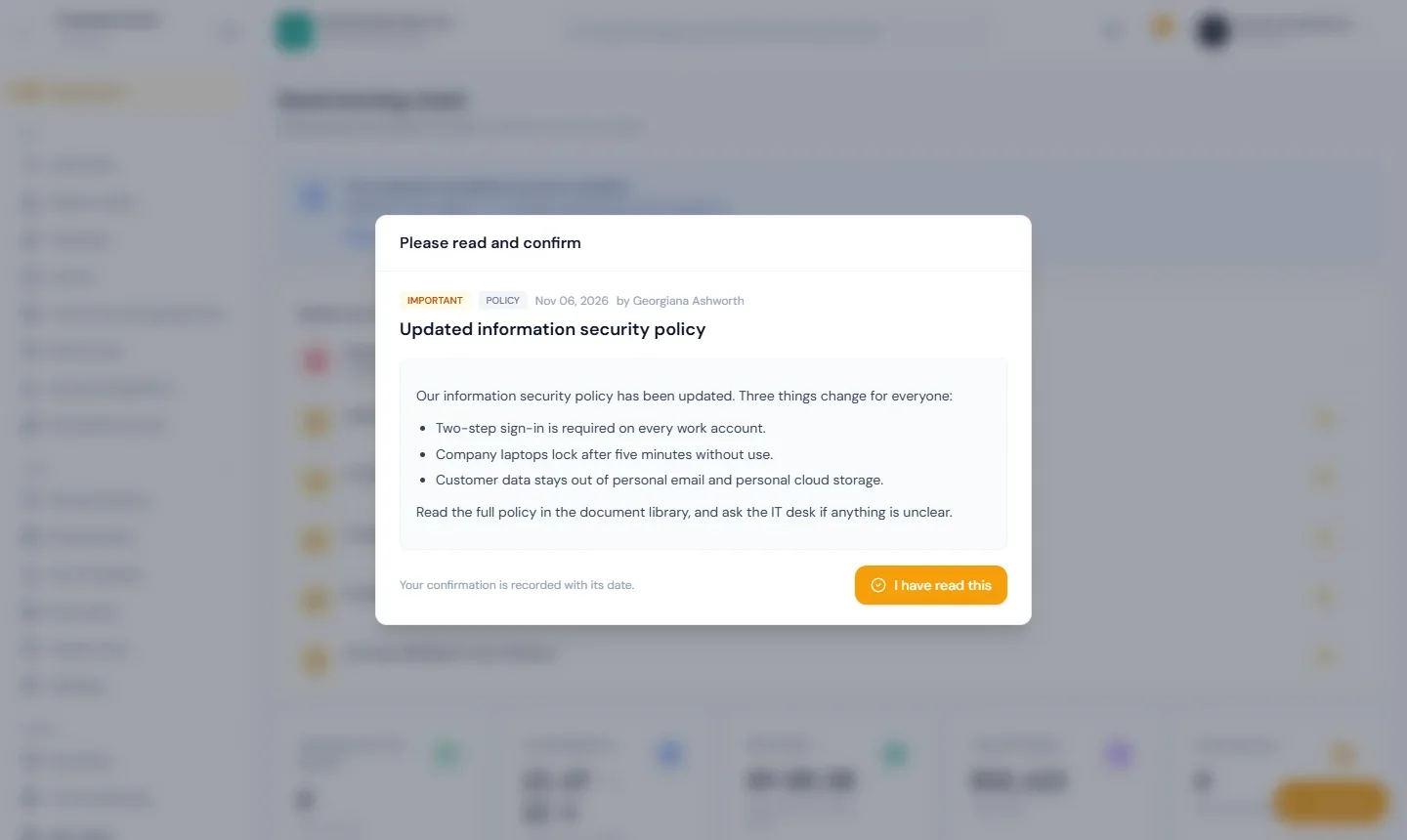
Two safeguards are built in. The screen never locks anyone out: if the list cannot be loaded it is not shown, and if a confirmation cannot be saved the person can close it and is asked again on the next load. And an administrator signed in as another user is not shown that person's must-reads and cannot confirm for them.
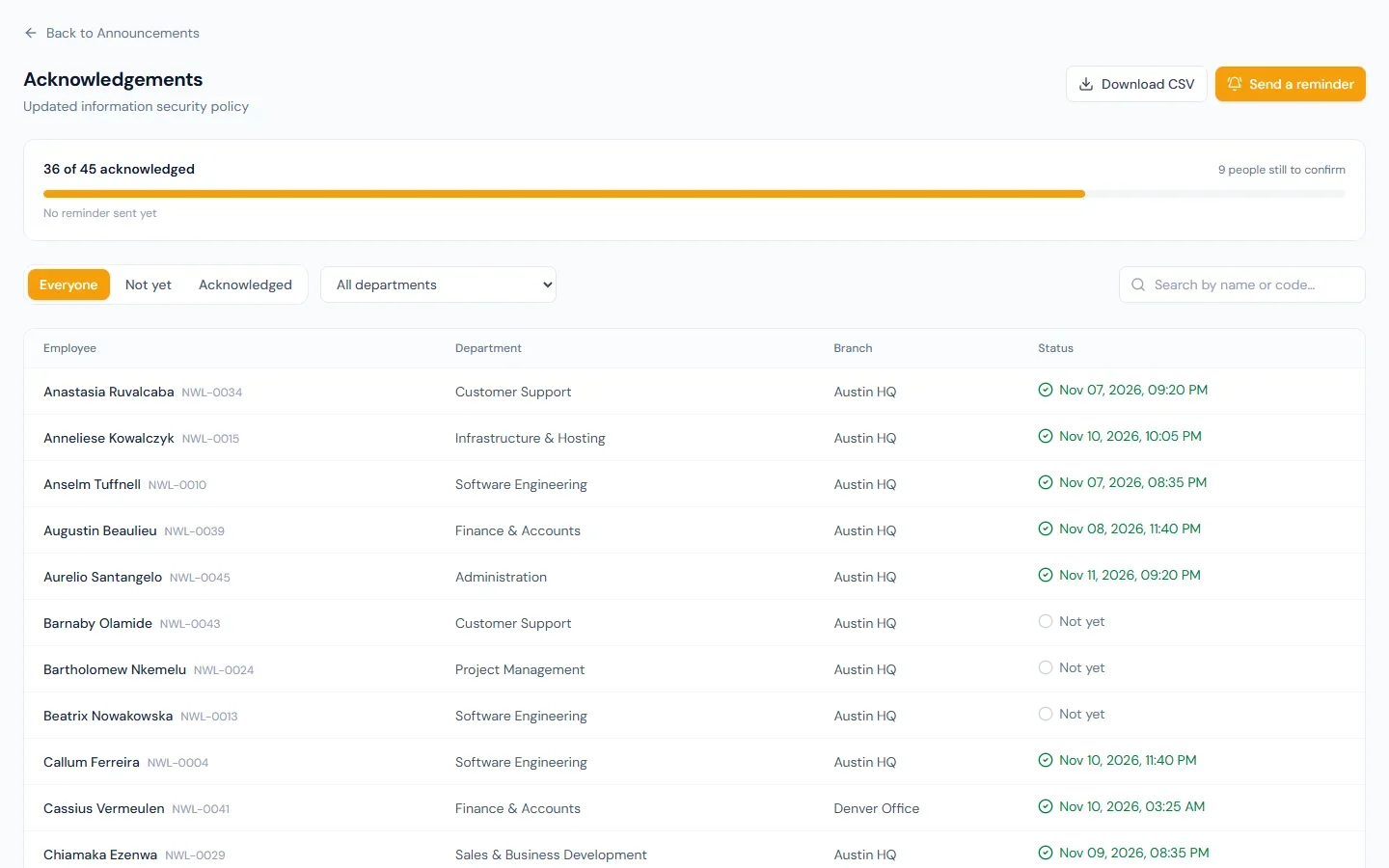
On the admin list a must-read card shows N of M acknowledged, and See who opens the roster: the count over the whole audience, each person with their department, branch and the time they confirmed (or Not yet), filters by status and department, a search, Download CSV and Send a reminder. The reminder emails the people who have not confirmed and can go out once in 20 hours for an announcement. Northwind has one must-read, "Updated information security policy", which most of the workspace has confirmed.
A published announcement can be edited from its card. On a must-read, the form then offers Ask everyone to confirm again. Leave it off for a correction that changes nothing people agreed to; tick it when the content has changed in substance. Everyone is then asked again, the people who had confirmed are told it has changed, and the roster shows them as Confirmed an earlier version until they do.
The knowledge base (Chapter 81b) and the document library can ask for a confirmation too. They ask from their portal page and by email; a must-read interrupts. Keep the policy itself in one of those and announce the change with a must-read.
78.6 Reactions and comments
Both are off in a new workspace. Reactions and comments on the announcements list has one switch for each, and they apply to every announcement.
With reactions on, a reader chooses one of five (Like, Celebrate,
Support, Insightful, Thanks); choosing another replaces it and
choosing the same one again removes it. With comments on, readers
write plain text of up to 2,000 characters under the announcement.
Anyone who can read the announcement can take part, and so can anyone
who manages announcements, so an author can answer under their own
post. A comment is deleted by its author or by anyone with
announcements.manage. Switching either off hides what was already
there without deleting it.
What happens next
- Chapter 79 covers the emails Operentra sends, the announcement email among them.
What the employee sees
The announcements meant for them, pinned ones first, on the portal home and the Announcements page, and an email for the ones sent with a notification.
Common mistakes
- Everything to everyone. Target the audience, or people stop reading.
- Everything urgent. Keep Urgent for what is.
- No expiry on time-bound notices. Stale items crowd the board.
- Scheduling a draft. Publish At only applies once it is published; publish it with the future date.
- Email on every announcement. Save it for what cannot wait.
- Treating "read" as agreement. A read is not an acknowledgment; use Must read when you need one.
- Making everything a must-read. Each one interrupts every person in its audience. Keep it for what they have to confirm.
- Asking again for a typo. Tick "Ask everyone to confirm again" only when what people confirmed has changed.
Practice
Use your own trial workspace, not a customer's.
- Create a category and an announcement for one department, scheduled for an hour from now, with an email.
- Publish it; sign in as someone in that department and someone outside it, and compare their boards before and after the hour.
- Pin it, then archive it, and check the board again.
Quiz
1. What does "Role" target?
Users holding the chosen access roles, not job titles.
2. When is a scheduled announcement emailed?
When it goes live: within ten minutes of its Publish At, once.
3. What happens at Expires At?
It leaves the board; its status stays Published until it is archived.
4. Who receives the email?
Active employees in the audience with an email address; those who sign in also get a bell notification.
5. Can admins see who has read an announcement?
They see how many: each published card shows a read count. For names, make it a must-read; its roster lists who has confirmed and who has not.
6. How does a must-read differ from an Urgent announcement?
Urgent is a label and a colour. A must-read stops each person in the audience until they confirm, and records each confirmation.
7. You fix a typo in a published must-read. Should everyone confirm again?
No. Leave "Ask everyone to confirm again" off; the confirmations stand. Tick it only when the content has changed in substance.