Chapter 94 — Plans and billing
An HR system is paid for, and HR is often the team that owns the subscription. Knowing how the bill is worked out avoids surprises: why it rose after a hiring month, why a feature shows a lock, what happens when a trial ends or a card fails. This chapter covers the plans, the trial, seats, the Billing page and the states a workspace can be in.
What this chapter covers
- 94.1 Plans and what they include
- 94.2 The free trial
- 94.3 Seats: what you pay for
- 94.4 The Billing page: plan, cycle, seats, invoices
- 94.5 Offer codes and lifetime licences
- 94.6 Cancelling, and what read-only means
The concept
Most HR software is priced per employee per month, so the bill follows the size of the workforce. Two details decide what you really pay: who counts as an employee (do leavers? new hires not yet started?) and the minimum the plan bills. Plans differ by the modules they unlock; the right one is the smallest plan that covers the work you do in the system, not the one with the longest list.
How Operentra handles it
- Three public plans, billed per employee, with a 10-seat minimum; yearly billing costs ten months instead of twelve:
| Plan | Per employee a month | Adds |
|---|---|---|
| Starter | $3 | Employee records, attendance, leave, self-service |
| Growth | $6 | Payroll, biometric devices, recruitment, performance with recognition, the roster and kiosk (Scheduling), skills management, timesheets, surveys, custom approval flows, learning |
| Enterprise | $9 | Custom domain, backups, GPS attendance and field visits, more than one workspace under one login (Multi-company), the People Analytics Pivot, integrations |
Brand Studio (ID cards, visiting cards, email signatures) is in no plan: a workspace in regular use unlocks it with an honest review on G2 (94.5).
The AI assistant (Chapter 98) is on every paid plan and in the free trial. Each plan gives the workspace one monthly pool of AI credits for it: a base, plus an amount for each billed seat (94.3). At launch the plans carry:
| Plan | Base a month | Per billed seat |
|---|---|---|
| Starter | 500 | 20 |
| Growth | 1,000 | 40 |
| Enterprise | 2,000 | 80 |
| Custom | 1,000 | 40 |
| AppSumo Tier 1 / 2 / 3 / 4 | 250 / 500 / 1,000 / 1,500 | — |
A trial gets a smaller trial allowance (300 credits a month at launch). Northwind, on Enterprise with 47 billed seats, gets 5,760. Operentra can change these figures; the Usage & credits page shows your own. Credit packs add more, and purchased credits never expire (Chapter 98).
- A feature your plan lacks stays visible in the menu with a lock; opening it explains which plans include it. Brand Studio before the workspace is in regular use is left out of the menus instead (Chapter 5). What a feature already made stays on file: ID cards issued while Brand Studio was on, for example, keep verifying and can still be revoked (Chapter 81).
- Who counts: every employee who has not left (new hires included); people who have left stay on file and are never billed.
- Billing & Subscription (
company.settings: Super Admin, HR Manager) shows the plan, seats, next payment and invoices. Payments are handled by Stripe.
Walkthrough
The Billing page of a trial workspace, from the admin menu.
94.1 Plans and what they include
The plan table above is the whole difference between plans; everything not listed (records, attendance, leave, documents, contracts, onboarding, offboarding, letters, announcements, reports for the modules you have, the portal, the API) is on every plan. Payroll is the usual reason to move from Starter to Growth. Multi-company is what lets someone who runs this workspace open another under the same login (Chapter 4); being invited into another company is never limited. A locked page says "not part of your current plan" and highlights the plans that include it.
94.2 The free trial
A new workspace starts a 14-day free trial of Enterprise, with no card (Chapter 4). The Billing page shows "Free trial ends in N days" and the date. Choose a plan before it ends to keep working; if you do not, the workspace becomes read-only (94.6) until you do.
Because the trial is the top plan, the plan you choose is often a cheaper one. Each plan card that leaves out something the workspace already uses says so in an amber note, for example "Not in this plan, and in use now: GPS attendance & field visits". Choosing it locks those pages; nothing you set up is deleted, and moving back up unlocks them. "In use" means real set-up: a payroll run, an active device or GPS site, a field visit, a job opening, an appraisal cycle, a saved custom domain, a backup taken by hand, a published roster day or a kiosk, a skill on someone's record, an approval flow of your own, a survey, a timesheet, a saved People Analytics view, or a connection or calendar link from the integrations. Brand Studio is not on the list: no plan includes it, so no plan change takes it away. The plan-recommendation emails near the end of the trial suggest the cheapest plan that keeps all of them. A custom domain is the one thing a trial cannot finish: it can be verified, and it connects once a plan is chosen.
94.3 Seats: what you pay for
The bill is seats × price per employee, where seats is the highest of: your current headcount (everyone who has not left), the seats you chose to hold, and the plan's 10-seat minimum. The Billing page shows the Billed seats, any spare seats ("Your next 2 hires won't raise the bill") and what each new employee adds. Headcount is synced every night, so a month of hiring shows on the next invoice; someone who leaves stops counting once the exit is complete.
Manage seats lets you hold extra seats ahead of hiring (never fewer than your current headcount). An increase is charged straight away for the rest of the period and takes effect once that payment clears; a decrease costs nothing now and shrinks the next invoice.
94.4 The Billing page: plan, cycle, seats, invoices
Billing & Subscription, "Your plan, seats, invoices, and payment settings", shows:
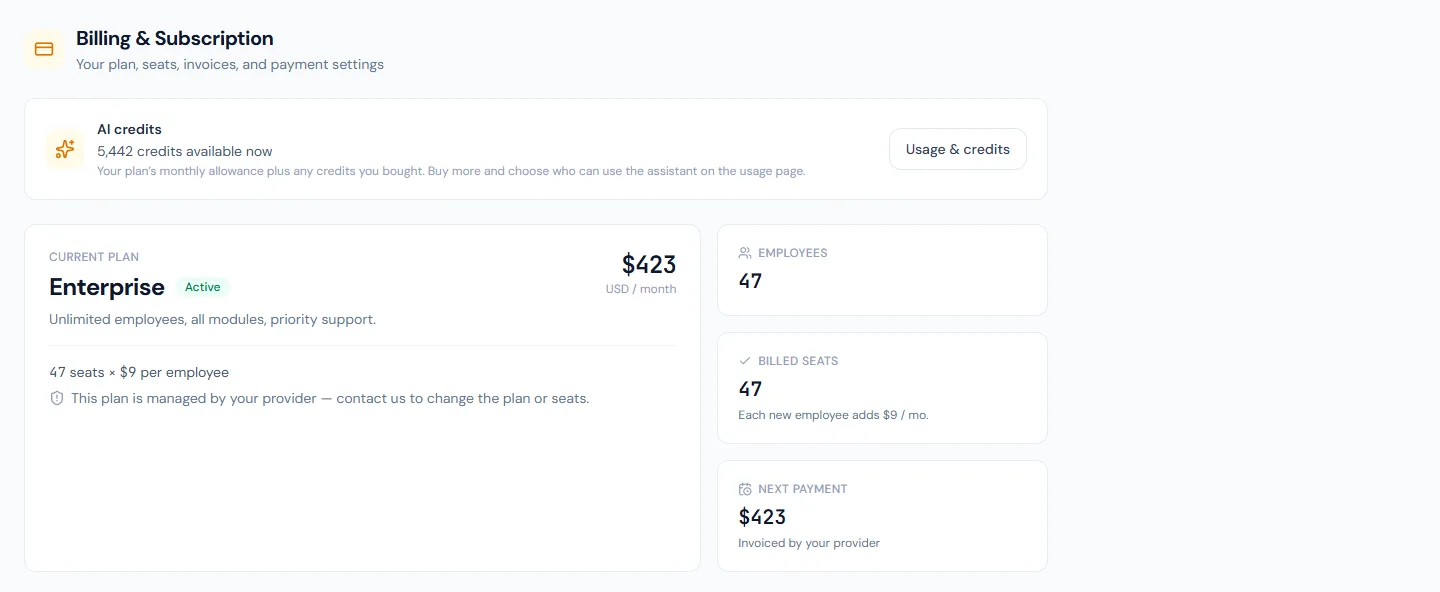
- Current plan with its status (Trial, Active, Payment overdue, Canceled, Expired), what you pay ("10 seats × $6.00 per employee") and when it renews or ends;
- Change plan and Switch to yearly/monthly billing: changes apply at once, and Stripe invoices or credits the difference for the current period;
- Manage seats (94.3);
- Payment methods & billing portal, Stripe's page for cards and billing details;
- Invoice history, each invoice with its period, status and a PDF;
- AI credits: the credits available now (what is left of the month's allowance plus any bought) and Usage & credits, the page where credits are bought and shared out (Chapter 98).
If a payment fails, the page says "Your last payment failed" and asks for a new payment method; Stripe retries the charge and the workspace keeps working meanwhile.
94.5 Offer codes and lifetime licences
Under Have an offer code?, a valid code gives the first month or months free: choose a plan, add a card (nothing is charged that day), and billing starts when the free months end, unless you cancel before. The page then shows "Free until" with the date.
Workspaces bought through a lifetime-licence deal see their tier ("lifetime licence") and its employee limit instead of seats; they can move to a paid plan at any time. Workspaces whose plan is arranged directly with the provider see "Managed by provider".
Until the workspace has Brand Studio (Chapter 81), which no plan includes, the page also offers Unlock Brand Studio free with an honest review, and so does every locked Brand Studio page. The offer appears once the workspace is in regular use: at least 10 active employees and a payroll run approved, locked or paid (on a plan without payroll, attendance recorded on 15 of the last 30 days); before that, Brand Studio isn't in the menus at all, and its pages, opened from a link, say Not available yet (Chapter 5). Write an honest review of Operentra on G2 (any rating counts, and if G2 asks whether you were offered anything for it, the answer is yes), then send the review's link and a screenshot with Send for checking. The platform checks only that the review is published and is yours. Once it is approved, Brand Studio is switched on for the workspace and stays on whichever plan it moves to; if it isn't, the email and the page say why, and you can send it again. The offer is for G2 only: Trustpilot doesn't allow any reward for a review. The offer is the same during the free trial, and a review approved then keeps Brand Studio on whichever plan the workspace moves to.
94.6 Cancelling, and what read-only means
Cancel subscription asks the main reason and cancels at the end of the period you paid for: full access continues until then, and Keep my subscription undoes it. Nothing is deleted.
A workspace whose trial ended, or whose subscription ended, is read-only: everyone can still sign in and see everything, and HR can export its data (Chapter 93), but nothing can be changed, except the billing page itself, so choosing a plan brings it straight back, and each person's own profile in the portal. The Billing page says why and since when, for an ended trial: "This workspace is read-only until you choose a plan — your data is safe and nothing has been deleted."
What happens next
- Chapter 95 starts Part 17 with the integrations hub.
What the employee sees
Nothing about billing. In a read-only workspace, the portal can be read but requests cannot be submitted.
Common mistakes
- Choosing by the longest feature list. Pick the smallest plan that covers the modules you use.
- Forgetting leavers count until their exit is complete. Finish offboarding (Part 13) so they drop off the bill.
- Holding seats you will not use. The bill uses the higher of headcount and held seats.
- Letting the trial lapse during setup. Choose a plan before day 14; read-only stops all changes until you do.
- Cancelling to pause. Cancellation ends at the period's close; consider a smaller plan instead.
Practice
Use your own trial workspace, not a customer's.
- Open Billing and note your trial end date, seats and price per employee.
- Open a locked page (Payroll on Starter, for example) and read which plans include it.
- Add two test employees and watch the headcount on the Billing page after the nightly sync.
Quiz
1. What are you billed for?
Seats × price per employee, where seats is the highest of headcount, seats you hold, and the 10-seat minimum.
2. Do employees who have left count?
No. Everyone who has not left counts, new hires included.
3. Which plan first includes payroll?
Growth.
4. What happens when the trial ends without a plan?
The workspace becomes read-only: viewable and exportable, nothing can change, until a plan is chosen.
5. When does a cancellation take effect?
At the end of the period already paid for; it can be undone until then.