Reports
The Reports area brings together read-only, exportable reports drawn from every part of your workspace — people, attendance, leave, payroll, tax, loans, and appraisals. Open it from the admin sidebar or go to:
/admin/reports
Every report is generated live from your current data, can be narrowed with filters, and can be downloaded as a CSV file. Reports are read-only: they never change any underlying record.
Reports require the Reports permission. If you don't see the Reports section, ask your workspace administrator to grant it to your role.
The Reports hub
The hub shows a card for each report category. Click View Reports on a card to open that category, then switch between its sub-reports using the tabs at the top of the page.
| Category | Opens at | What it covers |
|---|---|---|
| Employee Reports | /admin/reports/employees | Directory, headcount, demographics, joiners and leavers |
| Attendance Reports | /admin/reports/attendance | Monthly summaries, late arrivals, absences, overtime |
| Leave Reports | /admin/reports/leave | Utilization, balances, and applications |
| Payroll Reports | /admin/reports/payroll | Monthly and yearly payroll, component and bank breakdowns |
| Tax Reports | /admin/reports/tax | Monthly deductions, year-to-date, slab analysis |
| Loan Reports | /admin/reports/loans | Outstanding balances, schedules, defaulters, disbursements |
| Appraisal Reports | /admin/reports/appraisals | Ratings, cycle completion, increment recommendations |
| People Analytics | /admin/reports/analytics | Headcount and movements, attrition, absenteeism and the Bradford factor, overtime, leave liability, scheduled against actual hours, hiring, goals, and pivots |
The hub also shows an Audit Reports card. This one is a shortcut into the activity log
(/admin/audit/activity) rather than a report in this section.
What each category contains
Each category page groups related sub-reports under tabs. The sub-reports available today are:
Employee Reports
- Directory — full employee list, filterable by department, designation, branch, employment type, and status.
- Headcount — counts grouped by department, designation, branch, employment type, status, or gender.
- Demographics — a breakdown of the workforce by demographic attributes.
- New Hires — everyone who joined within a chosen date range.
- Anniversaries — upcoming work anniversaries within a horizon of days.
- Attrition — everyone who left within a chosen date range.
Attendance Reports
- Monthly Summary — per-employee attendance for a selected month and year.
- Late Arrivals — late entries over a date range.
- Absenteeism — absences over a date range.
- Overtime — overtime hours over a date range.
Leave Reports
- Utilization — leave taken across the fiscal year.
- Balances — allocated, used, and remaining leave per employee, broken out by leave type.
A leave type measured in hours is marked hours on both tabs. Its figures are hours, and they are totalled on their own: the Total column and the tiles show the days and, beside them, the hours, never one sum of both. The CSV does the same, with allocatedHours, usedHours and balanceHours next to the day totals and "(hours)" in the type's own column.
- Applications — leave applications submitted over a date range.
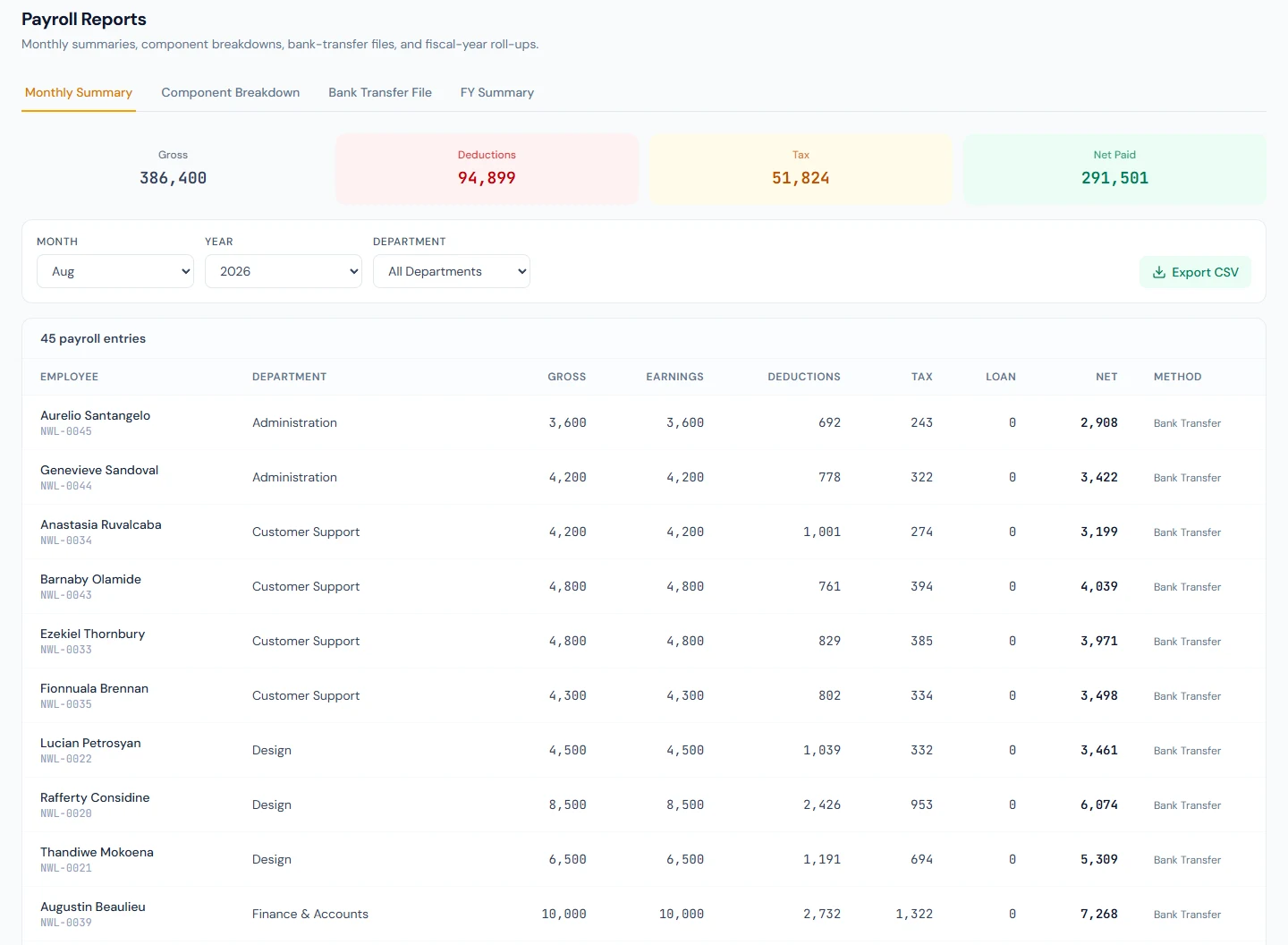
Payroll Reports
- Monthly Summary — payroll totals for a selected month and year.
- Component Breakdown — earnings and deductions split by salary component.
- Bank Transfer File — the per-employee amounts for a month's disbursement.
- FY Summary — payroll totals month by month across a fiscal year.
Tax Reports
- Monthly Deductions — income tax deducted in a selected month.
- YTD Summary — year-to-date tax per employee for a fiscal year.
- Slab Analysis — how employees distribute across tax slabs.
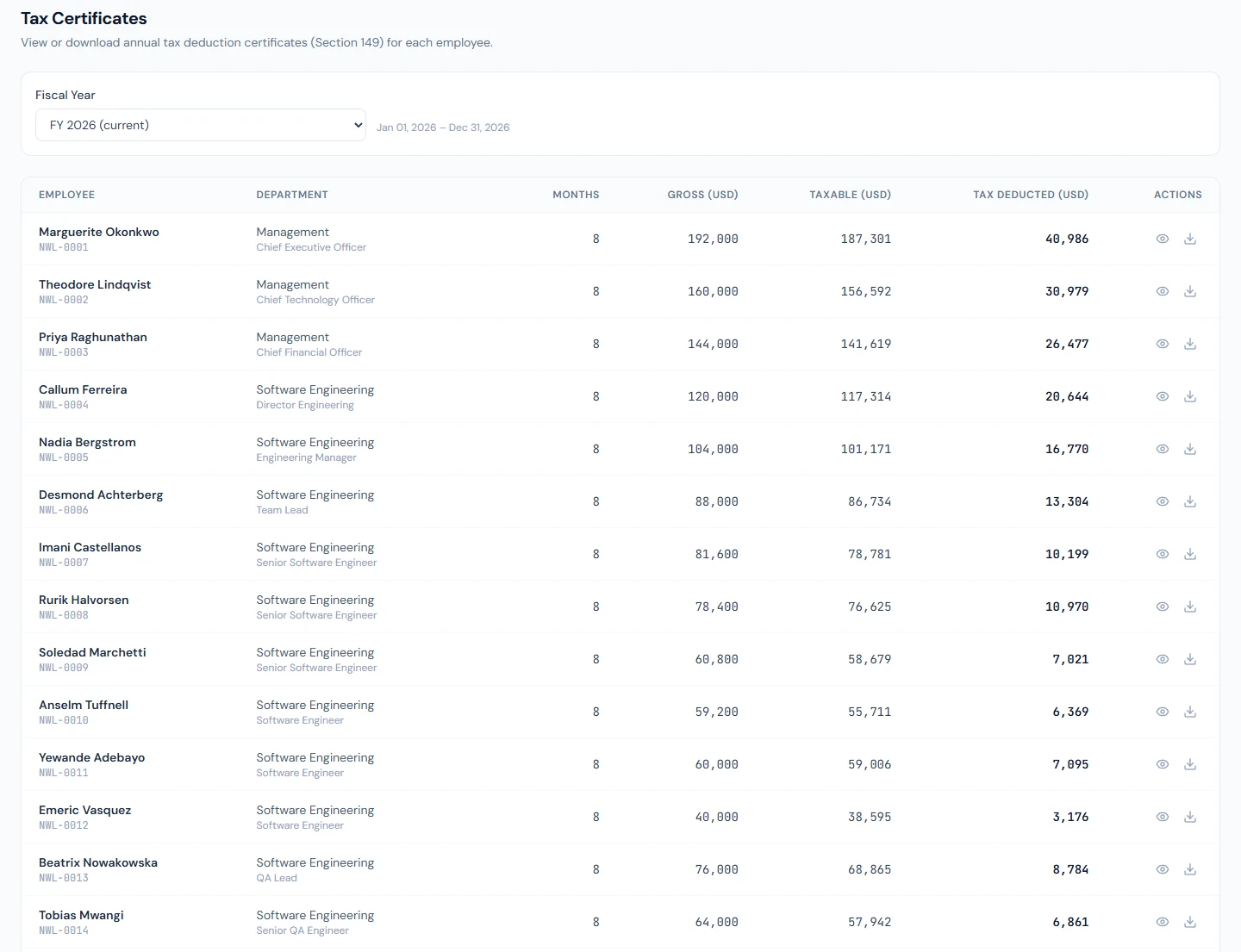
The YTD Summary, Slab Analysis and tax certificates count approved payroll only: runs that are approved, locked or disbursed. A month whose run is still in draft or review is left out until you approve it. Monthly Deductions shows the selected month's run whatever its status, with a notice above the table while that run is not approved yet.
In the monthly and year-to-date reports, and on tax certificates, Gross is the pay earned, not the contracted salary: every earning line, bonuses and payroll additions, less the days docked for absence, unpaid leave and late arrivals. Expense claims reimbursed through payroll are left out; an untaxed addition entered under Adjustments counts as pay. The monthly payroll report's Gross column is still the contracted salary, shown beside Earnings.
This category applies only where your country levies personal income tax. In a
no-income-tax workspace (the UAE, Saudi Arabia, and countries without a statutory
pack), the Tax Reports entry is removed from the sidebar and from sidebar search;
the hub card, if opened, shows a Not applicable in <your country> panel instead of
empty tables; and the server refuses the CSV export for these three report types (404).
Nothing is misconfigured — every figure would be zero by definition.
Loan Reports
- Outstanding — current loan balances, filterable by status.
- Repayment Schedule — instalments due across a month range.
- Defaulters — loans with a missed instalment for a month and year.
- Disbursements — loans disbursed over a date range.
Appraisal Reports
- Ratings Distribution — how appraisal ratings are spread across a cycle.
- Cycle Completion — how far a review cycle has progressed.
- Increment Recommendations — recommended increments and promotions from a cycle.
Skills Reports
With Skills management on: the skills matrix, people against skills, each cell the level held against the level the role requires, with gaps counted; filter by department and skill type; CSV export writes one line per person and skill.
People Analytics
The figures a board or an auditor asks for, over a window of dates (two years at most) and an optional department, each by month and by department, with a CSV on every table:
- Overview — the tiles: headcount and its change, joiners and leavers, annualised attrition, regretted leavers, absenteeism, people over the Bradford trigger, overtime hours and cost, leave liability, schedule coverage, time to hire, offer acceptance, goal completion and the latest eNPS (with Surveys), with the monthly headcount, attrition and absenteeism bars and the eNPS of each survey that closed in the window (Surveys). A survey that is still open is not shown, and an anonymous one under its group-size floor shows no score.
- Headcount — people employed at each month end, joiners, leavers and the net change.
- Attrition — leavers over the average headcount, per month and over the window, annualised; regretted leavers (the separations marked Regretted leaver on the offboarding form) and leavers by separation type.
- Absenteeism — absent days over working days, and the Bradford factor per person (absence spells squared, times days absent; 500 is the usual trigger for a conversation).
- Overtime — hours from attendance, cost from payroll where the plan includes it.
- Leave liability — the total of the latest nightly snapshot on or before each month end, with the date it was taken, and the latest one by leave type. Snapshots older than about two months are kept one per month (the month's last), so a window that ends inside an older month shows the month before it and says which date it read.
- Scheduled vs actual — rostered hours against hours worked, no-shows and unscheduled hours, by department.
- Hiring (with Recruitment) — days from application to hire, offers sent, accepted and declined.
- Goals (with Performance) — goals due and completed, on track, at risk and off track. Private goals are not counted.
- Pivot (with the People analytics plan feature, on the Enterprise plan) — one dataset (headcount, joiners, leavers, absent days, overtime hours or approved leave days) by department, designation, branch, employment type or gender, in total or by month, and views you save by name.
Every figure is measured from the records as they stand when you open the page, by each person's current department; a corrected attendance day or a cancelled separation changes the next read.
Filtering a report
Each page shows a filter bar above the results. The controls vary by report but come from a common set:
- Month / Year — for reports scoped to a single payroll or attendance month.
- From / To dates — for range-based reports such as new hires, late arrivals, and applications.
- Department — narrow most reports to a single department, or leave it on All Departments.
- Fiscal Year — for leave, tax, and payroll-summary reports; defaults to the current fiscal year.
- Status / Group by — extra controls on specific reports (for example, headcount grouping or loan status).
Adjust the filters and the table updates in place. Empty results show a short "nothing to show" message rather than an error.
Exporting to CSV
Every report has an Export CSV button. Click it to download the currently filtered rows as a
.csv file — the download respects whatever filters you have applied. The file is named for the
report and, where relevant, its period (for example attendance-2026-07.csv or
leave-balances.csv).
Where a report lists the employee's identity number, the column is headed with your workspace's own document, such as Social Security Number in the US or Emirates ID in the UAE. The tax reports include an NTN column only in Pakistani workspaces, or when an employee has one on file.
CSV is the export format for these reports. To share a report in another format, open the CSV in a spreadsheet app and export from there.
Employee tax certificates (self-service)
Employees don't need to ask HR for a tax certificate — they can download their own from the employee portal at:
/portal/tax-certificates
The page lists one card per fiscal year in which at least one month of the employee's payroll has been approved. Each card shows:
- The fiscal year and its date range, with a CURRENT badge on the in-progress year, and the number of approved months it covers.
- Summary tiles for Gross, Taxable, and Tax Deducted amounts.
- View — opens the certificate PDF in a new tab.
- Download — saves the certificate PDF (named after the fiscal year).
The card, the PDF and the admin Tax Certificates list count approved months only (runs that are approved, locked or disbursed). A month you have processed but not yet approved is left out, and appears once you approve it; send an approved run back to review and it drops out again until it is re-approved. During the year the totals cover the months approved so far; once every month of the year is approved, the certificate is the employee's record of income tax deducted at source. If an employee's user account isn't linked to an employee record, the page tells them to contact HR instead.
This portal page exists only in income-tax countries — where none is levied, employees never see a Tax Certificates entry in the portal, so don't point staff there in a UAE-type workspace.
Certificates appear automatically once you approve an employee's first payroll — there is nothing for HR to publish per employee. Point staff to Tax Certificates in the portal whenever they ask for a salary-and-tax summary.